Published May 4, 2026
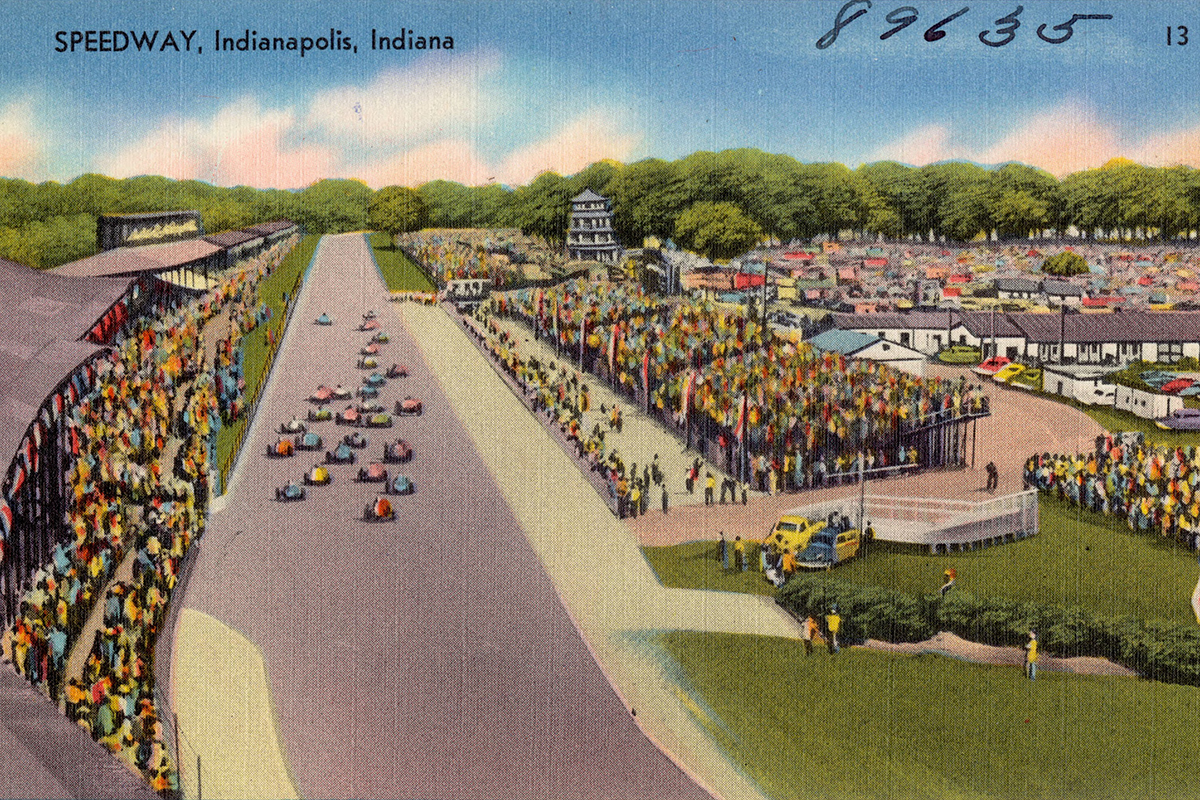
Every May, you can feel the excitement and anticipation in the air throughout the whole city of Indianapolis as everyone gets ready for “The Greatest Spectacle in Racing”—the Indianapolis 500. This race, which happens on the Sunday before Memorial Day, is known to be the biggest one-day automobile event in the world. More than 300,000 people head to the Indianapolis Motor Speedway to watch 33 drivers do 200 laps on the 2.5 mile track (driving a total of 500 miles by the end of the race) while millions more watch on TV.
This incredible event has made Indiana famous all around the world, having taken place almost every year on the same track since 1911. But how exactly did this automobile race come to be, and how has it become the sporting spectacle it is today?
Building the Track
In the early 1900s, the automobile industry was booming, especially in Indianapolis. By 1908, it was the fourth biggest automobile producer in the whole United States. But with all these new cars came the need to test them before they were sold. So, in 1909, Carl G. Fisher and his three business partners, James Allison, Arthur Newby, and Frank Wheeler, built the Indianapolis Motor Speedway about five miles northwest of the city.
This 2.5-mile oval was designed to have long stretches of track with gradual turns so that cars could really be pushed to the maximum during testing or, as Fisher and his partners thought, during the occasional automobile race. While the track was originally built entirely out of bricks, it was eventually replaced by asphalt. The only part of the original track is the start/finish line, which is still made up of those same bricks from 1911.
The First Race
On May 30, 1911, a crowd of 85,000 came out to the Indianapolis Motor Speedway to watch the inaugural Indianapolis 500. Before the race began, track founder Carl Fisher drove his Stoddard-Dayton around the track for one lap with the 40 cars competing in the race driving behind him. After this first lap, Fisher pulled off to let the drivers officially start the race, which is believed to be the first time a “pace” car was used to start this type of automobile race and was also the first mass rolling start for an automobile race.
After 6 hours and 42 minutes of driving, with an average speed of 74.6 mph, driver Ray Harroun won the race with the car now known as the Marmon Wasp.
The Indy 500 Through the Decades
Over the next few years, the Indianapolis 500 became a destination for international drivers looking to race. However, the outbreak of World War I made it difficult for the race to continue. In 1916, the race only went for 300 miles instead of the full 500 due to war conservation efforts, with many European drivers notably absent as they were fighting in the war instead. In 1917, just as the US was about to enter the war, the Indianapolis 500 was canceled altogether.
During World War I, the government used the track to refuel planes and test aircraft and the town of Speedway down the road hosted military barracks. Finally, in 1919 after the war had ended, the Indianapolis 500 was back on, this time with only 33 drivers. As the race went on, it became clear that Howdy Wilcox, a Hoosier, was going to win the race, prompting a local band to start playing the song “Back Home Again in Indiana” in the stands. Decades later, attendees would hear this song played again at the start of the race, and every year after that.
In 1927, former racecar driver and World War I pilot Captain Eddie Rickenbacker bought the track and continued the Indianapolis 500 tradition up until the US joined World War II in 1941. When that happened, Rickenbacker announced that there would be no more races until after the war ended. He offered up the track for the government to use, like in World War I, but the newer planes were too fast and too large to make the track useful.
By the end of the war in 1945, the track had fallen into disrepair, and on November 14, a man named Tony Hulman purchased it and spent the next few years repairing and restoring the track to its former glory.
The Indy 500 Today
Even today, the Indianapolis 500 is still a world-renowned event. In 2025, people came from all 50 states and 40 different countries to watch the race in person.
Before the race, you can always expect a performance of the song “Back Home Again in Indiana,” which began as an annual tradition in 1949 and has become the longest and one of the most beloved traditions of the Indianapolis 500. Actor and singer Jim Nabors performed the song before the race 36 times between 1972 and 2014, many times accompanied by the Purdue University All-American Marching band. These days, singer Jim Cornelison has taken up the mantle and keeps the tradition alive.
You’ll also hear the owner of the track make an announcement, a custom that started in 1968, when owner Tony Hulman told the drivers, “Gentlemen, start your engines!” For years, Hulman made that same announcement until 1977, when driver Janet Guthrie became the first woman to qualify for the race, a huge accomplishment in the male-dominated sport of racecar driving. That year, Hulman announced, “In company with the first lady to qualify at Indianapolis, gentlemen, start your engines!” Today, as more and more women have qualified and competed in the Indianapolis 500 over the years, the phrase has been adapted to “Drivers, start your engines!”
To start the race, the 33 cars who are competing line up three-by-three at the start line in order of their qualification times. Each car has the same distinctive body that sits low to the ground and uses either a Honda or Chevrolet engine—and these cars are designed to go fast. In the last five years, the average speed of the winning drivers has ranged from 167 mph to 190 mph. The drivers follow the pace car around the track for three laps to warm up, going only around 110 mph, before the green flag waves and the race officially begins.
After 200 grueling laps and 500 miles around the track, the winner of the Indianapolis 500 gets to take part in some of the most famous traditions of racecar driving: being presented with the Borg-Warner Trophy, drinking from a bottle of milk, and kissing the bricks of the start/finish line on the track. The Borg-Warner Trophy, cast entirely in sterling silver, features the face, name, and average speed of every race winner all the way back to 1911. While posing with the trophy, the winning driver then gets handed a bottle of milk to drink, one of the more bizarre traditions that dates back to when driver Louis Meyer had just won his third Indy 500 in 1936 and was so parched that he asked for a glass of buttermilk to drink. After chugging their milk of choice, the driver then joins members of their race crew down at the track and kisses the bricks that form the start/finish line, a custom that started in 1996 after driver Dale Jarrett and his crew chief Todd Parrott had jokingly promised to kiss the bricks if they won. When they actually won the race, they made good on their promise, unintentionally sparking a whole new tradition.
The Indianapolis 500 has over a century of rich heritage and customs that make May the most exciting month here in the race capital of the world. So this month, when you see the checkered race flags go up around the city, lean into the fever and know that you’re one of millions of people all around the world who can’t wait for race day to come.
You can learn more about the history of the Indy 500 by visiting the Indianapolis Motor Speedway, or by checking out their website, here.